

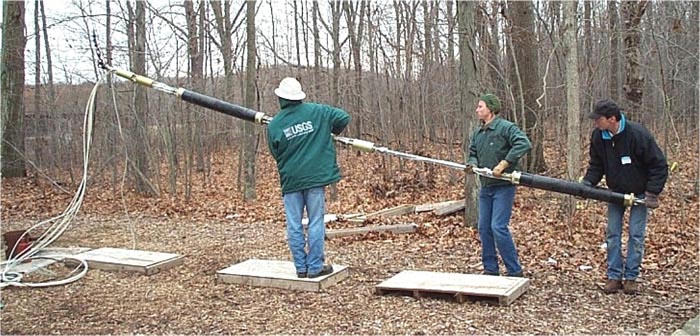
A water well packer seals off part of a well, so you can test, sample, pump or inject in one section without the rest of the well getting in the way. Aardvark Packers has been in business since 1968, and we build inflatable and mechanical packers for water wells in our Grants Pass, Oregon shop.
Tell us the casing or hole size, the depth and what you need to do in the well, and we will match the packer to the job.
Click Here to Contact Us or call 855-546-6488.
What water well packers are used for
A packer is a plug that seals a borehole or a casing. Once it is set, the section above it, below it or between two packers can be worked on its own. In water wells that usually means:
- Finding where the water comes from: isolate one fracture or screened interval, pump it and measure what it yields.
- Sampling one zone at a time: draw water from a single interval to find which part of the well the poor-quality or contaminated water comes from.
- Pumping with the rest of the well sealed off: run a test pump between packers or below one.
- Injecting or grouting a zone: pump water or grout into a single interval for testing, or to seal it.
- Controlling artesian flow: seal a flowing well at the casing so it can be capped, sampled or worked on.
Inflatable packers for open holes and casing
Our Tigre Tierra® inflatable packers are built for this kind of zone work. The gland is reinforced with steel cable, so it expands evenly along its full length, and the rubber cover presses into irregularities and fractures in an open hole to seal over the whole element.
- Eight sizes, from 1.2 in (30 mm) to 6.69 in (170 mm) at rest, inflating to as much as 13 in (330 mm).
- A sliding head lets one packer cover several hole sizes. Our model 58, 4.0 in (102 mm) at rest, works in 4½, 5 and 6 in holes, and in some applications up to 8 in.
- Inflate with compressed air, nitrogen or water. For inflation lines we recommend 3/16 in nylon tubing rated to 2,500 psi burst, which handles deep, high-head wells.
- Run the packer on drill rods, grout rods or iron pipe. Center tubes are stainless steel as standard.
- Standard glands are natural rubber, which hydrocarbons such as fuel will damage, so wells with that kind of contamination need Viton®-clad packers.
Testing one zone with a straddle string
Two packers on one string seal off the interval between them. Perforated steel tubing between the packers sets the length of the zone, and one inflation line fills both. Any of our packers can be joined this way and taken back to a single packer when the testing is done. See Straddle Packers.
Pumping with packers in the well
- Models 47 and 58 can be built with 2 in ID center tubes, so a small submersible pump can be lowered between the packers inside the center tube.
- Most packers can be pre-wired with pump leads, so a submersible pump can be spliced in below the packer.
- A straddle string with a pump uses a pump/packer mount.
Artesian and flowing wells: mechanical packers
A mechanical packer is set from the surface. You lower it into the casing and tighten the nut at the top, which squeezes the rubber element against the casing wall. There is no inflation line or gas bottle to manage, which suits flowing wells and installations that stay in place.
- Sizes for 2, 4, 6 and 8 in casing (51 to 203 mm), with custom sizes on request.
- Stainless steel bodies from 12 to 120 in long, so the seal can sit below the frost line.
- Elements in EPDM, nitrile, natural rubber or neoprene.
- Pass-throughs for transducer cables, vent lines, sampling or low-pressure injection, plus a check valve with a purge rod for sampling below the seal in freezing weather.
- A large-bore version with a 1.75 in ID mandrel for higher flow.
Getting the inflation pressure right
How much pressure an inflatable packer can take depends on how far it has to stretch. Its free-air (unconfined) rating is low; set in a hole, it holds far more. Our model 34B, 2.13 in at rest, is rated 185 psi unconfined, 700 psi inflated in a 3 in hole and 325 psi in a 4 in hole. The larger the hole for a given packer, the less pressure it can hold.
The pressure at the gauge also has to overcome the water standing above the packer. For a pump-out test:
G = [(Dp − Dw) × 0.43] + Sp + [(Dp − Dw) × 0.43 × 0.2]
G is the inflation pressure at the gauge (psi), Dp the depth to the top of the packer (ft), Dw the depth to static water (ft) and Sp the packer’s unconfined rating for the well size (psi). The total must stay below the packer’s confined rating for that well. The Inflatable Packer Manual gives the injection version, the confined pressure curves give the ratings by hole size, and our inflation pressure calculator does the math. Above ground, never test or inflate a packer beyond 25% of its unconfined rating.
Common questions
What size packer do I need?
Start with the casing inside diameter or the hole diameter. A packer that only has to stretch a little holds more pressure, so we size the at-rest diameter as close to the hole as is practical. Send us the size and depth and we will recommend a model.
Inflatable or mechanical?
Mechanical packers suit work near the top of a cased well: artesian control, sampling ports and long-term installations. Inflatable packers suit deeper work, open holes and jobs where the packer moves from zone to zone.
Can packers be repaired?
Yes. Our packers are built from modular parts, so glands, seals and O-rings can be replaced in the field, or you can send a packer back to us for a rebuild. See Packer Parts.
What if the well is contaminated?
Tell us what is in the water. We use Viton® for fuel, TCE and many other contaminants, and EPDM, nitrile or neoprene for other conditions. Our environmental packers are built for monitoring and remediation wells.
- Inflatable Packers: sliding-head Tigre Tierra® packers for open holes and casing, 1.2 to 6.69 in at rest
- Mechanical Packers: surface-set packers for 2 to 8 in casing, artesian flow control and sampling
- Straddle Packers: two or more packers on one string to isolate a zone
- Grout Packers: inflatable packers for pumping grout into a zone
- Environmental Packers: packers for monitoring and remediation wells
- Water test kits with flow meters, hoses, gauges and fittings
- Inflation regulators and manifolds
- Inflation tubing rated to 2,500 psi burst
- Water level indicators and pressure gauges
- 1 in grout hoses
- Replacement glands, seals and O-rings for field repair